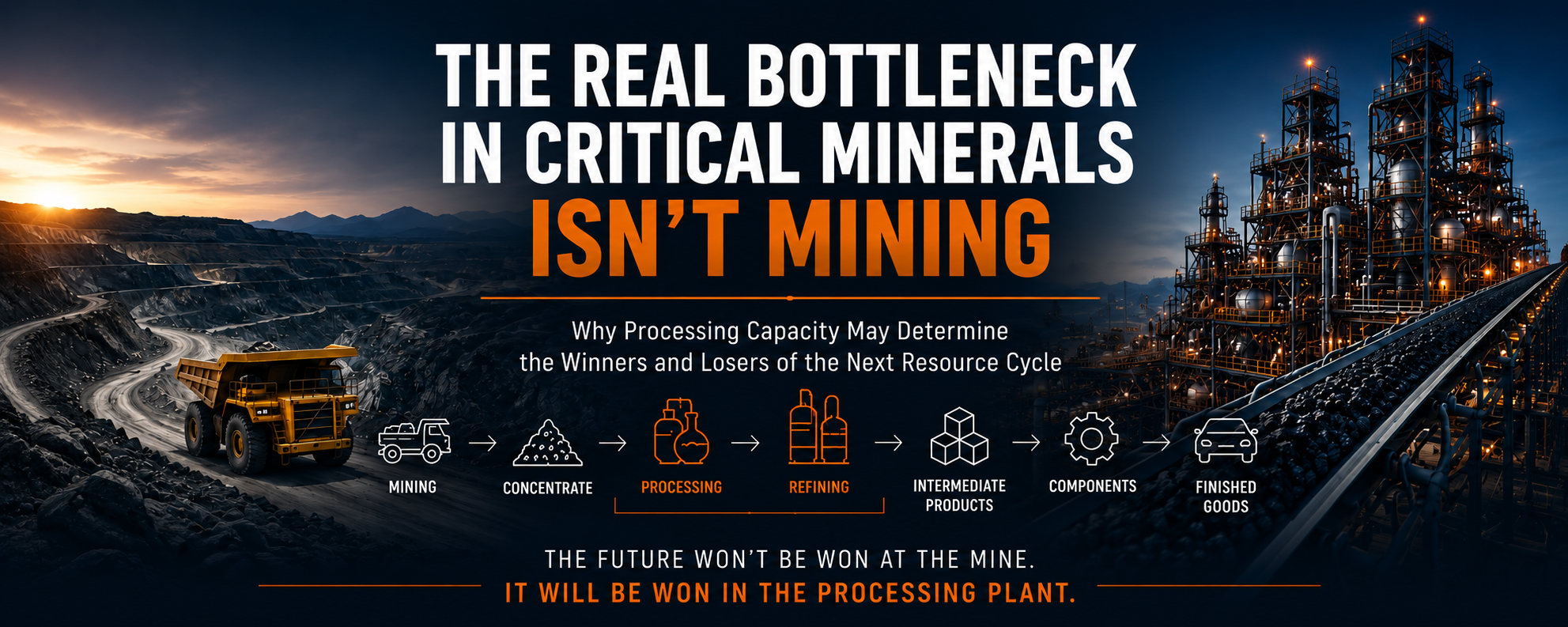
Why Processing-Not Geology-May Determine the Winners and Losers of the Next Resource Cycle
If you listened to the debate around critical minerals over the past five years, you would be forgiven for thinking the world’s biggest challenge is a shortage of mines.
Governments want more mines. Investors are financing more mines. Mining companies are racing to develop new deposits of lithium, rare earths, graphite, copper, nickel, and a host of other strategic minerals. Across North America, Europe and Australia, governments have launched critical minerals strategies designed to secure future supply and reduce dependence on geopolitical rivals.
At first glance, the logic is compelling. If the world needs more critical minerals, surely the answer is to mine more of them.
I believe that view misunderstands the problem.
The biggest bottleneck facing the critical minerals industry today is not discovering new deposits. It is transforming those deposits into products that industry can actually use.
Mining is only the first step in a long and technically demanding value chain. Ore must be concentrated, chemically processed, refined, purified and converted into intermediate products before it can be incorporated into electric vehicles, semiconductors, defence systems or aerospace components. Every stage requires specialist expertise, sophisticated processing technology, and years of operational experience. Increasingly, those capabilities are concentrated in China.

For much of the past three decades, Western economies focused on securing access to raw materials while quietly allowing much of their downstream processing capability to disappear. In doing so, they didn’t simply outsource manufacturing; they outsourced metallurgy, chemical engineering, refining technology, and much of the industrial know-how that transforms a mineral into a strategic material.
Governments are beginning to recognise this reality.
Investors, in my view, are only just catching up.
The Industry Has Been Solving the Wrong Problem
One of the more striking observations I’ve made over nearly two decades working across commodity markets is how predictable the industry’s response is whenever concerns emerge about future supply.
Find another deposit.
Develop another mine.
Increase production.
That approach made perfect sense for bulk commodities such as iron ore and coal, where mining represented the overwhelming majority of the value chain and downstream processing was relatively straightforward.
Critical minerals are fundamentally different.
Mining alone does not deliver supply security.

A lithium mine in Africa, a rare earth project in Australia or an antimony deposit in Central Asia has little strategic value if the material ultimately has to be shipped elsewhere for processing before it can be used. A tonne of concentrate sitting on a stockpile cannot manufacture a battery, produce a semiconductor or build a missile guidance system.
The strategic value lies further downstream.
That is where the conversation needs to move.
We Didn’t Lose the Resources. We Lost the Capability.
Perhaps the biggest misconception surrounding critical minerals is that China’s dominance is simply the result of superior geology.
In many cases, it isn’t.
China’s greatest competitive advantage is not necessarily what lies beneath the ground, but what it has built above it.
Over the past three decades, China invested consistently and strategically across the entire value chain. It developed processing plants, chemical refineries, metallurgical research institutes, engineering capability and downstream manufacturing. It built industrial clusters where mines, refineries, chemical plants and manufacturers evolved together, reinforcing one another through scale, experience and continuous innovation. It trained generations of metallurgists, chemical engineers and process specialists while often accepting lower margins than many Western competitors were prepared to tolerate.
Most importantly, China viewed processing as a strategic national capability rather than simply another manufacturing activity.
Many Western economies took the opposite approach.
As environmental regulations tightened, electricity prices rose and manufacturing gradually migrated offshore, processing capacity quietly followed. Refineries closed because they were no longer competitive. Others reached the end of their economic lives and were never replaced.
Over time, the West lost something far more valuable than physical infrastructure.
It lost experience.
A processing plant can be rebuilt.
A solvent extraction circuit can be redesigned.
New equipment can be purchased.
What is far more difficult to replace is the accumulated knowledge that sits inside an experienced workforce: the metallurgists who know how to optimise recoveries, the operators who understand how different ore types behave, the chemical engineers who solve processing problems that never appear in a flowsheet, and the long-standing relationships with industrial customers that take years to establish.
Industrial capability is built over decades and can disappear remarkably quickly.
That is the challenge many Western governments now face.
Rebuilding processing capacity will require considerably more than constructing another refinery or approving another mine. It will require rebuilding an industrial ecosystem that, in many cases, has been allowed to erode over an entire generation.
The Evidence Is Everywhere—If You Know Where to Look
This isn’t simply a Chinese story.
Nor is it unique to any single commodity.
Once you start looking across the critical minerals sector, the same pattern appears again and again. Countries that control processing increasingly control the market, while countries that merely extract raw materials capture only a fraction of the economic value.
The lesson is remarkably consistent, whether you’re looking at rare earths, aluminium, copper, antimony, or tungsten.
The details differ.
The conclusion does not.
Rare Earths: China Didn’t Corner the Market by Accident
Rare earths perhaps provide the clearest example of how industrial capability can matter more than geology.
China undoubtedly possesses significant rare earth resources, particularly its ionic clay deposits that host many of the heavy rare earth elements. However, geology alone doesn’t explain how it came to dominate one of the world’s most strategically important supply chains.
For decades, rare earth separation technology existed outside China. The United States processed rare earths at Mountain Pass, while South Africa developed downstream expertise through operations linked to Steenkampskraal. Gradually, however, environmental regulations tightened, operating costs increased and Western investment waned. At precisely the same time, China was investing heavily—not simply in mining, but in separation plants, chemical processing, research institutes and permanent magnet manufacturing.
That distinction is crucial.
Producing a mixed rare earth concentrate is only the beginning. Separating fifteen chemically similar rare earth elements into high-purity individual oxides is one of the most technically demanding metallurgical processes in the mining industry. It requires hundreds, sometimes thousands, of solvent extraction stages operating continuously and consistently over many years.
That isn’t expertise that can be recreated simply by announcing a new government funding programme.
It is an industrial capability accumulated over decades.

Aluminium: Cheap Power Wins
Aluminium tells a very different story, but arrives at exactly the same destination.
Unlike rare earths, aluminium isn’t constrained by complex chemistry. It’s constrained by energy.

Electricity typically accounts for between 25% and 40% of the cost of producing primary aluminium, making it one of the most electricity-intensive industries in the world.
As electricity prices rose across Europe and North America, many smelters became progressively less competitive. Production naturally migrated towards regions capable of supplying abundant, reliable and inexpensive electricity.
China dramatically expanded its aluminium industry.
Russia leveraged vast hydroelectric resources.
More recently, the Gulf states—including the UAE, Bahrain and Oman—have established globally competitive aluminium industries built on access to low-cost natural gas and modern infrastructure.
Meanwhile, much of the West quietly exited the business.
The limiting factor wasn’t access to bauxite. Australia still hosts some of the world’s largest bauxite operations, including Rio Tinto’s Weipa Mine and Alcoa’s Huntly Mine.
The limiting factor was affordable processing.
It is a lesson many critical mineral strategies still underestimate.
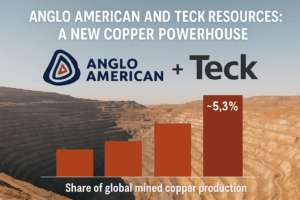
Copper: Mining Is Global. Refining Is Not.
Copper provides another example.
The world’s largest copper deposits are spread across Chile, Peru, the Democratic Republic of Congo, Zambia, Australia, Mexico and the United States.
Yet once copper concentrate leaves many of those mines, it frequently begins another journey—one that ends in a Chinese smelter.
Over the past two decades, China has invested aggressively in smelting and refining capacity, becoming the world’s largest producer of refined copper despite importing much of its concentrate.
The same pattern has emerged in cobalt and, increasingly, tin.
The Democratic Republic of Congo produces the majority of the world’s cobalt, but much of that material is refined in China before eventually finding its way into battery supply chains.
Indonesia has emerged as the world’s largest tin producer, yet downstream processing and manufacturing remain heavily concentrated elsewhere in Asia.
Again, the lesson is remarkably consistent.
Mining and refining are fundamentally different businesses.
And control over refining often delivers considerably greater strategic influence than ownership of the orebody itself.
Antimony: Metallurgy Matters
If one commodity illustrates the importance of processing expertise, it is antimony.
Unlike many industrial minerals, antimony deposits are rarely straightforward. Ores frequently contain economically significant quantities of gold, arsenic and other complex mineral assemblages. Recovering each metal efficiently requires sophisticated metallurgical optimisation.
Maximise gold recovery too aggressively and antimony recoveries may suffer.
Optimise for antimony and valuable gold may be left behind.
These are not theoretical problems.
They are commercial realities that determine whether a project succeeds or fails.
Chinese processors have spent decades refining these flowsheets, developing expertise that allows them to maximise value from multiple metals simultaneously. That knowledge has become a competitive advantage in its own right.
I encountered this challenge earlier this year while advising the developers of a new antimony project in Alaska.
One option considered was exporting the ore to Cambodia, Laos or Kyrgyzstan for processing before shipping refined antimony back to the United States.
On paper, the idea appeared feasible.
In reality, it quickly fell apart.
Shipping low-grade ore halfway around the world before returning the refined metal simply wasn’t economic. Yet establishing a domestic smelter presented its own challenges, from environmental permitting to the scarcity of processing expertise after decades of industrial decline.
The result was a sobering conclusion.
The United States possesses the resource.
What it increasingly lacks is the industrial capability to process it competitively.
That distinction lies at the heart of the critical minerals debate.
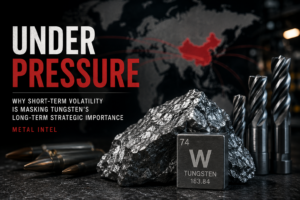
Tungsten Tells Exactly the Same Story
Tungsten follows a remarkably similar pattern.
Developing a tungsten mine is only the first step.
Producing a saleable concentrate comes next.
The real challenge lies in converting that concentrate into ammonium paratungstate (APT), tungsten oxides, metal powders, cemented carbides and ultimately the finished products used by manufacturers around the world.
Each stage requires specialist expertise, customer qualification, sophisticated processing technology and decades of accumulated operational experience.
For many years, China has dominated almost every one of those downstream stages.
Governments seeking to diversify supply have understandably focused on supporting new mining projects, both domestically and overseas.
That is an important first step.
But mining alone will not rebuild strategic independence.
Without corresponding investment in refining, chemical processing and downstream manufacturing, many of these projects risk producing concentrates that continue flowing into the very supply chains they were intended to diversify.
In other words, we have spent years trying to solve the mining problem while largely ignoring the processing problem.
And that, in my view, is where the real bottleneck lies.
Why Rebuilding Processing Capacity Isn’t as Simple as Building Another Plant
If rebuilding critical mineral supply chains was simply a matter of constructing new processing plants, the West would probably have solved the problem already.
It hasn’t.
The reason is straightforward: processing is one of the few parts of the mining industry where experience is almost as valuable as engineering.
Building a concentrator or designing a flotation circuit is undoubtedly complex, but these are disciplines the mining industry has practised for generations. Across the world, engineers know how to build mines.
Far fewer know how to build world-class critical mineral processing industries.
The difference is important.
Processing isn’t static. Flowsheets evolve over decades. Reagent suites are refined. Recoveries improve incrementally as operators learn how different ore types behave, how impurities affect downstream chemistry and how to consistently produce material that meets increasingly demanding customer specifications.
Much of that knowledge never appears on a process flow diagram.
It resides in the experience of metallurgists, process engineers and plant operators who have spent years solving problems that cannot be replicated in a laboratory.
Once that capability disappears, rebuilding it becomes extraordinarily difficult.
Rare earth separation illustrates the challenge perfectly. While the underlying chemistry is well understood, consistently separating individual rare earth oxides to commercial purity requires thousands of solvent extraction stages operating continuously under tightly controlled conditions. Very few organisations possess that capability, not because the science is secret, but because industrial experience cannot simply be bought off the shelf.
The same principle applies across almost every critical mineral.
Producing battery-grade lithium hydroxide requires impurity control that goes far beyond producing spodumene concentrate.
Recovering antimony without sacrificing associated gold recoveries demands sophisticated metallurgical optimisation.
Producing high-purity tungsten powders suitable for cemented carbide manufacture is an entirely different business to operating a tungsten mine.
These aren’t simply engineering problems.
They are industrial capabilities developed over decades.
Processing Requires More Than Technology
One of the biggest misconceptions surrounding critical minerals is that building a processing plant automatically creates a processing industry.
It doesn’t.
A refinery without secure feedstock quickly becomes uneconomic.
A processing plant without long-term customers becomes a stranded asset.
Even producing technically acceptable material is no guarantee of commercial success.
Industrial consumers—particularly those supplying aerospace, defence, semiconductor and automotive sectors—typically require extensive qualification programmes before approving a new supplier. Those programmes can take years, during which product quality, consistency and reliability are scrutinised in extraordinary detail.
Changing supplier is not simply a purchasing decision.
It is an operational risk.
As a result, established processors benefit from relationships and reputations that have often taken decades to build.
Breaking into those supply chains therefore requires considerably more than constructing a new refinery. It requires proving, repeatedly, that every tonne produced today will be identical to every tonne produced five years from now.
That level of confidence cannot be engineered overnight.
Energy May Be the Next Competitive Advantage
If chemistry explains why some countries dominate processing, energy explains why others struggle to compete.
Processing is energy intensive.
In many cases, extremely energy intensive.
The aluminium industry provides perhaps the clearest example. Electricity accounts for roughly one-third of the cost of producing primary aluminium, making power prices one of the industry’s most important competitive variables.
As electricity prices increased across Europe and North America, many smelters gradually became uneconomic. Production migrated towards jurisdictions capable of supplying abundant, reliable and competitively priced power.
China expanded aggressively.
Russia leveraged its hydroelectric resources.
The Gulf states—including the UAE, Bahrain and Oman—built globally competitive aluminium industries around low-cost natural gas and modern infrastructure.
The lesson extends well beyond aluminium.
As governments seek to establish domestic critical mineral processing industries, energy policy increasingly becomes industrial policy.
Countries capable of combining mineral resources with affordable electricity will enjoy a structural competitive advantage.
Those that cannot may continue exporting concentrates while importing the very products they hoped to manufacture themselves.
Industrial Capability Cannot Be Rebuilt Overnight
Perhaps the greatest misconception surrounding critical minerals is the belief that governments can rapidly recreate industrial capability simply by allocating more funding.
Money undoubtedly matters.
But capital alone does not create experienced metallurgists.
It does not train chemical engineers.
It does not qualify products into aerospace supply chains.
Nor does it rebuild industrial ecosystems that have gradually disappeared over several decades.
This is why I remain sceptical whenever politicians suggest that critical mineral independence can be achieved within a single electoral cycle.
I hope they’re right.
History suggests otherwise.
Industrial capability is built gradually.
It requires patient capital, consistent policy, technical education, operational experience and, above all, time.
The uncomfortable reality is that discovering the next world-class orebody may prove considerably easier than rebuilding the industrial capability needed to process it.

The Investment Mistake Everyone Is Making
Whenever I speak to investors evaluating critical mineral projects, the conversation almost always begins with the same questions.
Which company has the largest resource?
Which project has the highest grade?
Which mine sits lowest on the cost curve?
Those questions remain important.
They are no longer enough.
For decades, the mining industry operated on a relatively simple assumption: whoever controlled the resource ultimately controlled the market. That was largely true when the greatest source of competitive advantage lay in discovering and developing mineral deposits.
Today, I think that assumption is beginning to break down.
Increasingly, the companies creating the greatest long-term value are unlikely to be those with the largest resources alone. They will be those capable of controlling a greater proportion of the value chain.
Can they produce a concentrate that consistently meets increasingly demanding customer specifications?
Can they secure refining capacity outside geopolitically sensitive jurisdictions?
Can they manufacture intermediate products rather than exporting raw materials?
Can they qualify those products into aerospace, defence and semiconductor supply chains where reliability matters just as much as price?
Those questions are becoming every bit as important as resource size or operating costs.
For mining companies, the challenge is no longer simply to think beyond the pit.
It is to think beyond the mine itself.
For investors, it means looking beyond the resource statement.
And for governments, it means recognising that permitting another mine, while necessary, is only the first step towards genuine supply security.
The real competition is increasingly taking place much further downstream.
The Next Commodity Supercycle May Look Very Different
Much has been written about the possibility of another commodity supercycle.
Whether one emerges is almost beside the point.
The forces shaping the next decade are fundamentally different from those that drove the last.
The previous supercycle was powered by China’s industrialisation and an extraordinary expansion in demand for raw materials.
The next is more likely to be driven by geopolitics, industrial policy, defence spending and supply chain resilience.
Those forces reward different assets.
Owning a mineral deposit, valuable though it remains, may no longer be sufficient.
Increasingly, competitive advantage will accrue to companies—and countries—that can process, refine and manufacture strategically important materials at scale.
If that proves correct, the market may have been looking in the wrong place all along.
What the Market Is Missing
For years, investors have measured critical mineral projects by the size of the resource.
Governments have measured success by the number of new mines announced.
Both are increasingly using the wrong yardstick.
Mining creates concentrates.
Processing creates strategic capability.
A country that mines lithium but cannot produce battery chemicals remains dependent on somebody else.
A country that mines rare earths but cannot separate individual oxides still relies on foreign processing.
A country that exports copper concentrate but imports refined copper has captured only part of the value chain.
The defining competition of the next decade will not simply be about who owns mineral resources.
It will be about who controls the chemistry, metallurgy, engineering and manufacturing that transform those resources into products the world actually needs.
Final Thoughts
For much of the past decade, the critical minerals debate has focused almost entirely on geology.
Where are the deposits?
Who controls the resources?
How quickly can new mines be developed?
Those remain important questions.
They are no longer the most important ones.
The more difficult challenge is rebuilding industrial capability that has quietly disappeared over the past three decades.
Processing plants can be financed.
Equipment can be purchased.
New facilities can be constructed.
What is far harder to recreate is experience.
The metallurgical expertise accumulated over generations.
The chemical engineering capability.
The operational knowledge that never appears in a feasibility study.
The long-standing customer relationships built through years of consistently delivering high-quality products.
These are not assets that can be recreated overnight simply because governments now recognise their strategic importance.
They require time.
They require investment.
Above all, they require long-term commitment.
The irony is that many Western countries do not lack critical mineral resources.
They lack much of the industrial capability needed to transform those resources into products that modern economies—and increasingly modern defence industries—depend upon.
That, in my view, is the real bottleneck.
And until that changes, discussions about critical mineral security will remain incomplete.
Because ultimately, supply security is not determined by who owns the mine.
It is determined by who controls the value chain.
What’s Next
This article has explored why I believe processing—not mining—has become the defining challenge facing critical minerals.
Over the coming months, Metal Intel will examine how this broader theme is playing out across individual commodity markets, including antimony, tungsten, rare earths, uranium and copper.
Each market has its own unique characteristics.
Yet the underlying question remains remarkably consistent:
Who controls the value chain?
Answering that question will tell us far more about the future of critical minerals than simply identifying where the next mine will be built.
This article originally appeared in Metal Intel newsletter on LinkedIn. Metal Intel is an independent publication developed by Core Consultants covering commodity markets, critical minerals, geopolitics, and long-term resource investing.
Each edition explores the structural forces shaping global resource markets—moving beyond daily headlines to examine what they mean for investors, mining companies, industrial consumers and policymakers.
Work With Me
My work falls into four areas:
Strategic Advisory Commodity market studies, commercial due diligence, market entry strategy and investment screening for mining companies, industrial groups and investors.
Executive Consulting Independent advice on critical minerals, supply chains, offtake strategy, project evaluation and commercial strategy.
Speaking & Expert Networks Conference presentations, board briefings, executive workshops and expert consultations on commodity markets and critical minerals.
Research The Metal Intel Strategic Brief series provides in-depth analysis of commodity markets and long-term industry trends.
If your organisation is evaluating a commodity, project, acquisition or investment opportunity, I’d be happy to discuss how I can help.
About Core Consultants
Core Consultants is an independent commodity intelligence and strategic advisory firm specialising in critical minerals, mining, processing, commodity markets and investment strategy. We advise institutional investors, mining companies, industrial consumers and governments on market studies, due diligence, supply chain strategy and commercial advisory.
Selected capabilities include:
- Critical minerals market studies
- Commercial due diligence
- Supply chain and processing strategy
- Investment screening and project evaluation
- Price outlooks and strategic market intelligence
📩 For consulting enquiries or bespoke research:
🌐 www.coreconsultantsgroup.com