Gallium and germanium have become almost inseparable in the critical minerals debate. They appear together in announcements on Chinese export restrictions, government funding programmes and presentations promising investors exposure to defence, semiconductors and artificial intelligence.
Yet grouping them together tells us relatively little about either market.
The distinction matters now because alternative supply is beginning to move beyond government statements. Alcoa’s Wagerup gallium project reached a final investment decision in July. Metlen has secured a customer for part of its planned Greek production. In Canada, Teck is working towards expanding germanium recovery at Trail.
These developments deserve attention, but they do not represent the same supply response. Gallium’s emerging producers are largely seeking to recover additional value from established alumina operations. Germanium’s position depends more heavily on access to suitable feedstocks, recovery at existing smelters and the circulation of material through recycling.
For buyers assessing security of supply, and investors assessing where the returns might sit, these differences are more useful than another reminder that both metals are critical.
The restrictions have changed. The commercial problem remains.
There is an immediate reason to revisit these markets. China’s suspension of its US-specific export prohibition extends to 27 November 2026. The broader export-control framework remains in place. It would therefore be wrong to describe the December 2024 prohibition as simply continuing unchanged, but equally premature to assume that trade has returned to normal. [Reuters, CIRS]
For an industrial buyer, the distinction between being permitted to import a material and being able to obtain it reliably is substantial. A licence does not, by itself, settle delivery timing, availability or the ability to replenish stock when required.
This leaves buyers and prospective producers facing different versions of the same problem. Buyers must decide what dependable supply is worth. Producers must decide whether the premium will last long enough to justify an investment.
A relaxation in Chinese exports could ease immediate purchasing conditions well before new Western capacity is commissioned. A tightening could leave buyers exposed while those same projects are still being built. Neither outcome changes the time required to commission a recovery circuit and establish consistent product quality.
I would therefore be cautious about using the next policy announcement as a proxy for the longer-term direction of either market. The policy matters, but so does the industrial response taking place beneath it.
Germanium has already undergone a substantial repricing
The US Geological Survey’s annual germanium metal price series increased from US$1,392/kg in 2023 to US$1,991/kg in 2024 and an estimated US$4,100/kg in 2025. The 2025 figure was more than double the previous year’s level. [USGS]
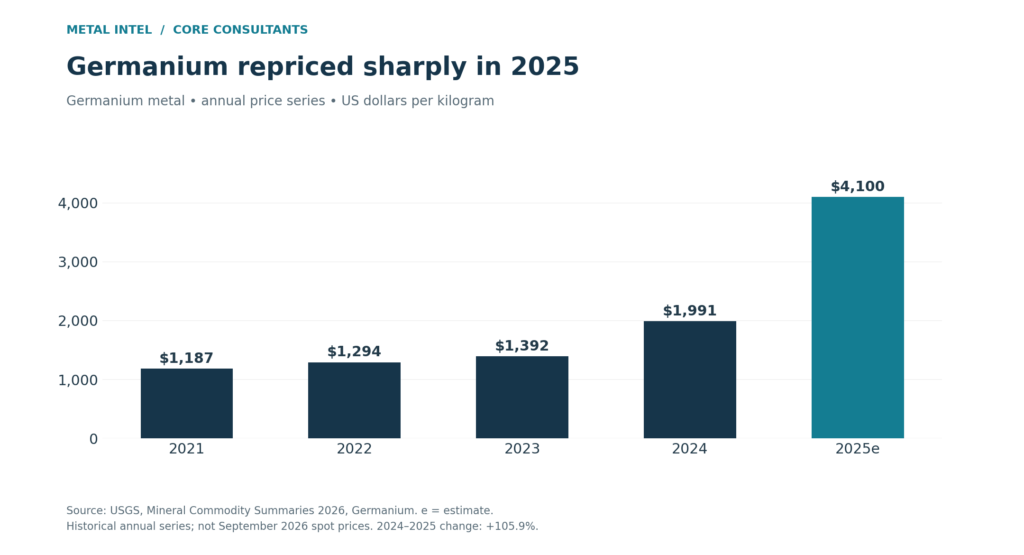
At these prices, more than the economics of proposed primary production changes. Material sitting in manufacturing scrap, inventories and residues becomes more valuable. Recovery processes that previously attracted little attention warrant another look. Customers have a stronger incentive to reduce losses and, where possible, use less metal in each finished product.
The response will not be uniform. An established processor with access to suitable material may be able to respond considerably sooner than a developer still demonstrating its metallurgy. Equally, a customer may improve recovery from its own manufacturing process before a new supplier reaches production.
Gallium has also seen a significant change in its pricing environment. In its August 2026 results, Metlen referred to prices above US$3,000/kg, compared with the US$1,000/kg assumption used at its capital markets day. This is a company-reported market indication rather than a disclosed realised selling price, but it illustrates why recovery projects are receiving attention. [Metlen]
The temptation is to apply these higher prices to announced capacity and calculate an attractive revenue number. I would resist that. The price available for a particular specification and delivery location today is not necessarily the price a new producer will receive several years from now.
Demand needs more explanation than “AI and defence”
Gallium’s semiconductor applications include gallium nitride and gallium arsenide. Within data centres, an important opportunity for GaN is in power conversion and distribution. Infineon, for example, positions GaN alongside silicon and silicon carbide in its data-centre power offering. [Infineon]
That is a credible source of demand growth. It does not, however, mean that a forecast for AI expenditure can be translated directly into a forecast for gallium consumption.
The calculation requires assumptions about technology adoption, the amount of gallium used per device, manufacturing yields and the recovery of process scrap. Strong growth in semiconductor revenues and strong growth in metal demand are related, but they are not interchangeable.
Germanium has a different set of exposures. Fibre-optic systems, infrared optics and specialist semiconductor applications are important, alongside its use in substrates for high-efficiency solar cells. Developments in communications, thermal imaging and space applications consequently matter to its outlook. [Teck, Umicore]
S&P Global’s August 2026 draft reports show differences in potential growth. Its gallium demand estimate rises from 1,000 tonnes in 2025 to 1,738 tonnes in 2030, while germanium increases from 343 tonnes to 408 tonnes. These represent increases of approximately 74% and 19%, respectively. These are published estimates and forecasts, not settled market totals, but the divergence is considerable. [Gallium report, Germanium report]
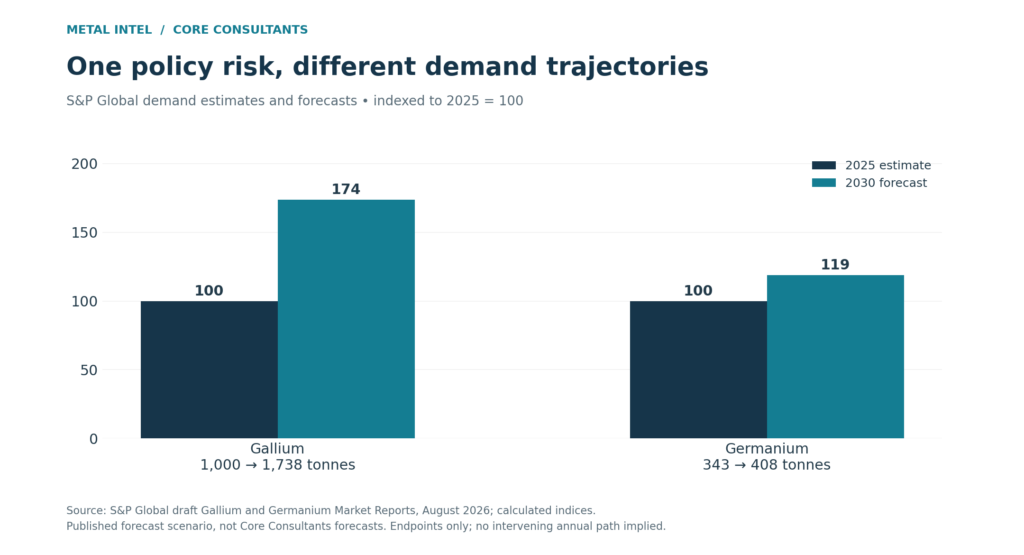
The stronger growth forecast does not automatically make gallium the better investment. That also depends on the supply response, the capital required and where margins are earned along the chain.
Gallium’s new producers already have an industrial base
The commonly cited Chinese dominance figure requires some precision. USGS estimates that China accounts for 99% of worldwide primary low-purity gallium production. This is an upstream measure. It should not be applied indiscriminately to high-purity refining or finished semiconductor production. [USGS]
What interests me about the emerging alternatives is the type of company developing them.
Alcoa’s Wagerup project in Western Australia has an announced capacity of 100 tonnes a year. JOGMEC confirmed the final investment decision in July 2026, alongside Alcoa, Sojitz and government-related partners. This is a meaningful development, although an investment decision is still some distance from sustained commercial output. [Alcoa, JOGMEC]
Metlen is developing 50 tonnes a year in Greece, with first production expected in the second half of 2027. Its July agreement with a US technology customer covers approximately one-quarter of planned annual output. The agreement provides evidence of customer demand ahead of commissioning, although the publicly available terms do not establish the project’s eventual realised margin. [Metlen results, Supply agreement]
Rio Tinto is at an earlier stage in Canada. Its pilot is expected to operate in 2027, with plans for a demonstration plant producing up to four tonnes annually and a potential commercial operation of 40 tonnes. The demonstration and commercial figures describe stages of development, not two separate additions to supply. [Rio Tinto]
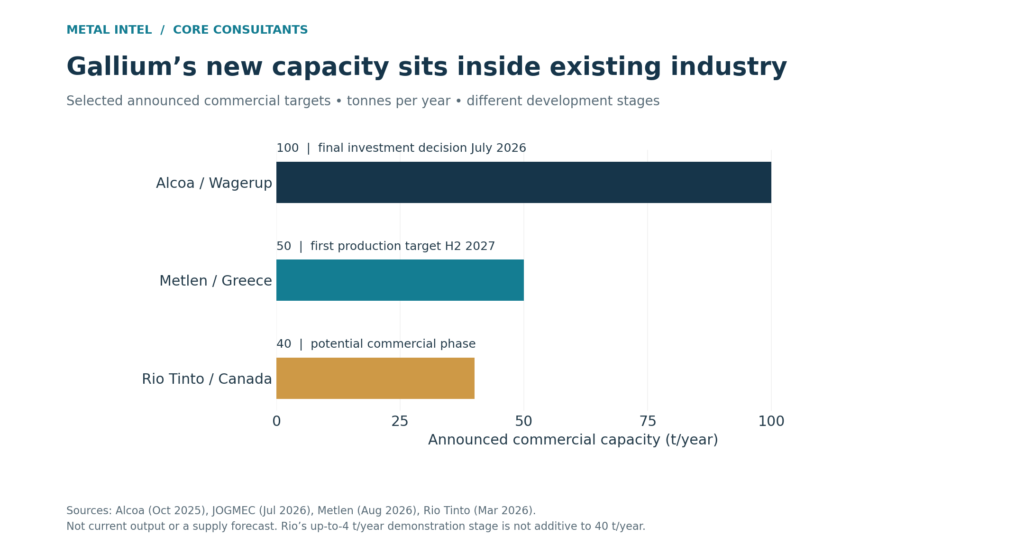
These projects have something important in common: they are being developed around existing alumina operations. The opportunity begins with an established industrial process from which additional material may be recovered.
There are still technical and commercial hurdles. Nevertheless, the route to additional gallium supply is quite different from discovering, permitting and constructing a new standalone mine. That gives the market a potential medium-term response which should be considered alongside its present concentration.
More zinc does not necessarily mean more germanium
Germanium is recovered mainly as a by-product of zinc processing. That relationship is sometimes taken too far when assessing future supply. Higher zinc production does not automatically deliver proportionately more germanium. [USGS]
The questions are more specific. Does the feed contain economically recoverable germanium? Where does it report during processing? Is there a suitable recovery circuit, and can that circuit operate consistently with the available feed?
This is why the recent activity around Teck’s Trail operations is relevant. In July, Teck and Canadian government partners announced a framework supporting investment that could double existing germanium and antimony capacity and potentially introduce gallium production. The potential C$850 million investment relates to the broader strategic-metals programme. It is not a standalone germanium project cost, and the arrangements remain subject to further agreements and approvals. [Teck]
The feedstock work is equally instructive. In May, Titan Mining and Teck’s Trail operations agreed to evaluate germanium recovery from existing processing streams at Empire State Mines in New York. This remains an evaluation rather than a production commitment, but it addresses the practical issue: finding material that can support an actual recovery operation. [Titan Mining]
For germanium, I would place considerable weight on this work. A large host-metal operation may look impressive in a supply database while contributing very little to the recoverable germanium market.
Recycling changes the primary supply requirement
Germanium’s supply response also extends beyond primary recovery.
Umicore states that more than half of its germanium feed comes through its recycling technology. This is a figure for Umicore, not the global industry, but it demonstrates the commercial importance of secondary material. [Umicore sourcing]
The company is also developing reusable substrates that allow more than 95% of the germanium substrate material to be reused. That should not be interpreted as an equivalent reduction in current industry-wide demand. It does, however, show the direction of some of the technological effort. [Umicore reusable substrates]
High prices encourage customers to recover more material and reduce the amount lost in production. Where performance requirements permit, they also encourage changes in design and material intensity.
Consequently, growth in finished products can coexist with a much slower increase in the requirement for newly produced metal. Any demand model that counts additional satellites, infrared systems or optical fibre without considering these material flows risks overstating the call on primary supply.
Where does that leave the opportunity?
There remains a credible case for supply risk in both markets. Trade policy can change faster than plants can be built, and announced capacity provides little comfort to a customer requiring qualified material today.
Over a longer period, however, I would assess the two metals differently.
For gallium, the central issue is how successfully established alumina operators convert recovery projects into dependable commercial output. If they do, the market must absorb a supply response that could change the premium available to later entrants.
For germanium, I would focus more closely on the quality and availability of feedstocks, performance at existing recovery facilities and the contribution of recycling. Those factors may prove more informative than the number of projects carrying germanium in their presentations.
The investment implications follow from this. Ownership of a resource is only one possible source of value. Control of suitable feed, an operating recovery process and an established customer base may be more valuable—although, within a diversified producer, the financial contribution could remain relatively small.
That is where I would direct the analysis now. We already know these metals are strategically important. What we need to establish is which businesses can supply them consistently, at what cost, and with what margin once the immediate shortage premium has changed.