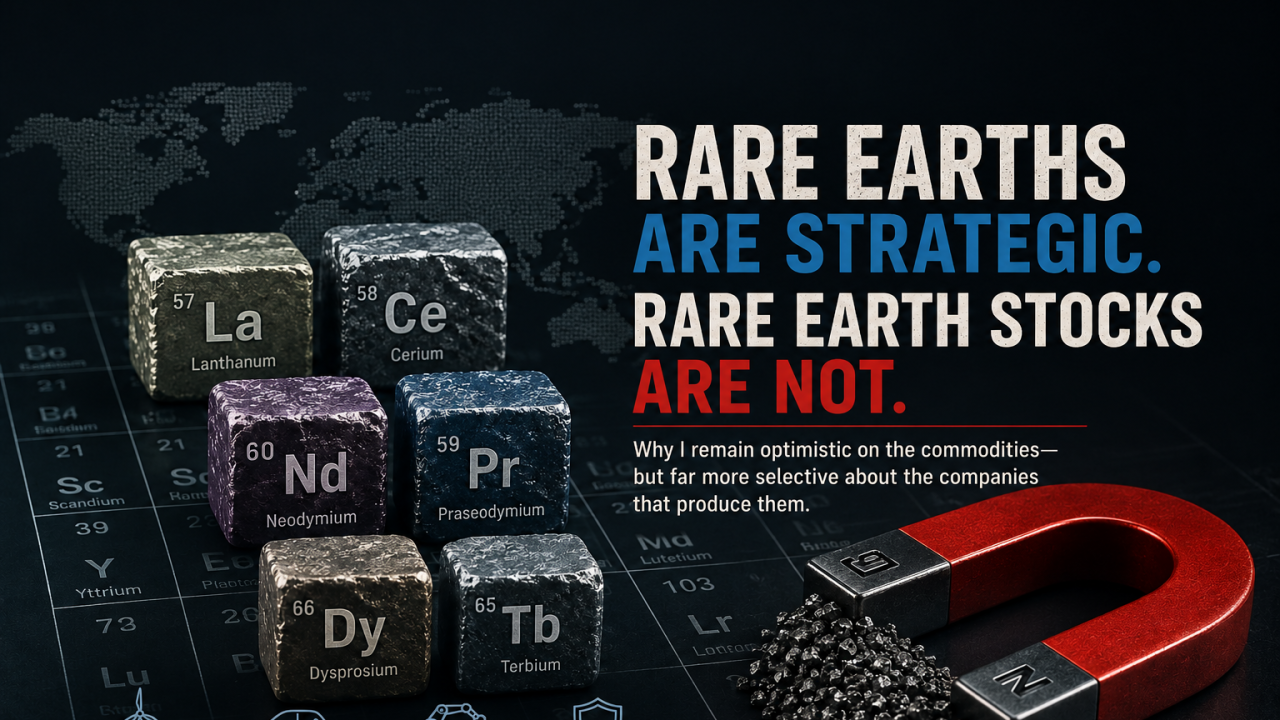
Why I remain optimistic on the commodities, but far more selective about the companies that produce them
Why I would happily own the material—but rarely the mining company.
One of the questions I am asked most frequently is remarkably simple.
“Which rare earth stock should I buy?”
My answer usually surprises people.
None of them.
That doesn’t mean I believe rare earths are unimportant.
Quite the opposite.
I believe rare earths have become one of the world’s most strategically important groups of commodities. They underpin permanent magnets used in electric vehicles, wind turbines, robotics, defence systems, precision-guided weapons and countless other advanced technologies. Governments around the world increasingly describe them as “critical minerals”, and supply security has become a matter of national policy rather than simply industrial procurement.
I don’t believe that automatically makes rare earth mining companies attractive investments.
The distinction matters.
Because owning a strategically important commodity is not the same thing as owning a profitable mining business.
History has shown that investors repeatedly confuse the two.
We Have Been Here Before
In many respects, today’s rare earth market feels eerily familiar.
Back in 2010 and 2011, China dramatically tightened exports through quotas and restrictions, triggering one of the most spectacular commodity price rallies of the past two decades.
Prices for neodymium, dysprosium and several other rare earth oxides exploded.
Investors rushed into the sector.
Governments scrambled to finance alternative supply chains.
Junior exploration companies appeared almost overnight, each promising to become “the next non-Chinese producer.”
The narrative seemed compelling.
China controlled supply.
The West needed alternatives.
Rare earth prices could only move higher.
It proved to be one of the mining industry’s most expensive lessons.
Prices eventually collapsed.


Many projects never entered production.
Others required repeated recapitalisations, substantial shareholder dilution or government support simply to survive.
The strategic importance of rare earths never disappeared.
The investment thesis did.
That distinction remains just as relevant today.
This Isn’t 2011
Many commentators argue that we are witnessing a repeat of 2011.
I disagree.
The outcome may ultimately prove similar for some investors, but the mechanism is fundamentally different.
In 2011, China largely controlled exports through quotas.

Today, China continues to export significant quantities of rare earth products.
The difference is who receives them.
Increasingly, exports are governed through licensing regimes, product-specific controls and approvals that prioritise qualified industrial users and strategically important supply chains.
Material continues to leave China.
It simply no longer flows as freely through global commodity markets as many investors assume.
This is a far more sophisticated approach.
Rather than restricting exports broadly, China is increasingly influencing where material ultimately ends up and which industries receive priority access.
This point is often overlooked. For investors, however, it changes the investment landscape entirely.
The Market Still Doesn’t Understand Rare Earths
One of the biggest misconceptions is that rare earths behave like copper, iron ore or lithium.
They don’t.
People frequently talk about “rare earth prices.”
There is no such thing.
Rare earths are not one commodity.
They are a collection of more than a dozen individual markets, each with its own supply-demand dynamics, pricing and strategic importance.
Yet investors continue to value companies largely on total rare earth oxide resources.
That is a mistake.
A deposit dominated by cerium and lanthanum has a fundamentally different economic profile from one containing significant quantities of neodymium, praseodymium, dysprosium or terbium.
Size alone tells you very little.
Basket composition tells you a lot more.
A smaller deposit with a high proportion of magnet rare earths may ultimately prove far more valuable than a giant resource dominated by lower-value light rare earths, depending, of course, on the capital requirements relative to the grade and size of the resource.
Investors should stop asking:
“How big is the resource?”
They should start asking:
“What is actually inside it?”
The Rare Earth Investor’s Checklist
Before I invest in any rare earth company, I ask ten questions.
If several of the answers are “no”, I usually move on.
1. What are they actually producing?
Not all rare earths are equal.
How much of the revenue comes from:
- Neodymium?
- Praseodymium?
- Dysprosium?
- Terbium?
Or is the project primarily producing cerium and lanthanum?
The value of the basket matters far more than the size of the resource.
2. What proportion of revenue comes from magnet rare earths?
This may be the single most important question.
Permanent magnets remain the fastest-growing and strategically most important application for rare earths.
A company producing meaningful quantities of NdPr and heavy rare earths occupies a very different position from one selling predominantly low-value light rare earths.
3. Is it simply a mine—or an integrated business?
Mining is only the beginning.
Can the company:
- separate?
- refine?
- produce metals?
- manufacture alloys?
Every downstream step captures additional value.
The companies most likely to succeed are increasingly those moving further along the value chain rather than simply exporting a mixed concentrate. Moreover, processors pay precious little for a mixed concentrate, and it’s extremely challenging to find a home for this product outside of China.
4. Who actually buys the product?
Customers matter.
Has the company qualified with automotive manufacturers?
Magnet producers?
Defence contractors?
Industrial OEMs?
Or is management assuming someone will eventually buy the material?
In the rare earths sector, customer qualification often takes years. In general, these premium customers purchase only separated, high-grade rare earths. If a producer cannot separate its material, it is forced to sell to an intermediary or solvent extraction companies and separation facilities. The majority of these are based in China, though some emerging Western facilities are able to purchase limited quantities of niche material.
5. Can China replace the supply?
This is perhaps the most uncomfortable question.
Even if a project works technically…
Would it still be competitive if Chinese producers increased production or reduced prices?
Many projects look attractive only when prices remain unusually high.
6. Does the capital intensity make sense?
Large resources attract headlines.
Capital efficiency creates shareholder returns.
A project requiring several billion dollars to develop may never deliver attractive returns, regardless of its size.
I would rather own a smaller, higher-quality project with manageable capital requirements than a world-class resource requiring extraordinary investment before producing its first kilogram of oxide.
Resource size should always be considered alongside capital intensity.
7. Can it survive without government support?
Government funding is becoming increasingly common.
That does not necessarily mean the underlying economics work.
Would the project remain commercially viable without grants, subsidies or strategic financing?
If the answer is no, investors should understand exactly where the risk lies.
8. Can the company survive another 2012?
Commodity cycles always turn.
If NdPr prices fell by half tomorrow…
Would the company still generate cash?
Or would shareholders face another round of dilution?
9. Where does processing actually occur?
This takes us back to a theme I’ve explored before.
Mining is rarely the bottleneck.
Separation is.
Metal production is.
Magnet manufacturing is.
Owning a mine is only part of the equation. This is particularly critical with respect to rare earths as all the value is in the separated metal oxides.
10. Why does this company exist?
Is it:
- a strategic national asset?
or
- a business capable of generating attractive long-term returns?
or
- a junior mine, playing to a market theme hoping to attract capital and raise the share price?
These are not always the same thing or have the same prospects.
Investors should understand what they are buying.
Companies Are Not Equal
This does not mean every rare earth company should be viewed the same way.
Companies such as Lynas Rare Earths and MP Materials have progressed well beyond the traditional junior explorer model. They have invested in downstream processing, secured strategic partnerships and become important components of emerging non-Chinese supply chains.
That places them in a different category to early-stage exploration companies whose investment case depends primarily on proving up larger resources.
Even so, they remain exposed to many of the structural challenges facing the sector: volatile pricing, long customer qualification cycles, significant capital requirements and competition from an established Chinese industry.
Being among the strongest companies in a difficult sector does not eliminate the sector’s inherent risks.
I Would Rather Own the Material
If I could choose between owning physical neodymium oxide and owning many rare earth mining companies, I would choose the material. Though I recognise this is not generally possible.
The commodity does not suffer shareholder dilution.
It does not require permitting.
It does not need to finance processing plants.
It does not need to qualify customers.
It simply reflects supply and demand.
Mining companies, by contrast, must overcome every one of those hurdles before shareholders see meaningful returns.
That difference explains why strategically important commodities have often delivered disappointing equity returns.
Investment Takeaways
Rare earths remain among the world’s most strategically important commodities.
That does not automatically make rare earth mining companies attractive investments.
Before investing, I care less about resource size than I do about basket quality, capital intensity, downstream integration, customer relationships, and long-term competitiveness.
Because in rare earths, the question isn’t simply whether demand will grow.
It almost certainly will.
The more important question is:
Who actually captures the value?
Sometimes, that will be the miner.
Sometimes, it will be the processor.
Sometimes, it will be the magnet manufacturer.
And sometimes…
It may simply be the owner of the material itself.
This article originally appeared in Metal Intel newsletter on LinkedIn. Metal Intel is an independent publication developed by Core Consultants covering commodity markets, critical minerals, geopolitics, and long-term resource investing.
Each edition explores the structural forces shaping global resource markets—moving beyond daily headlines to examine what they mean for investors, mining companies, industrial consumers and policymakers.
Work With Me
My work falls into four areas:
Strategic Advisory Commodity market studies, commercial due diligence, market entry strategy and investment screening for mining companies, industrial groups and investors.
Executive Consulting Independent advice on critical minerals, supply chains, offtake strategy, project evaluation and commercial strategy.
Speaking & Expert Networks Conference presentations, board briefings, executive workshops and expert consultations on commodity markets and critical minerals.
Research The Metal Intel Strategic Brief series provides in-depth analysis of commodity markets and long-term industry trends.
If your organisation is evaluating a commodity, project, acquisition or investment opportunity, I’d be happy to discuss how I can help.
About Core Consultants
Core Consultants is an independent commodity intelligence and strategic advisory firm specialising in critical minerals, mining, processing, commodity markets and investment strategy. We advise institutional investors, mining companies, industrial consumers and governments on market studies, due diligence, supply chain strategy and commercial advisory.
Selected capabilities include:
- Critical minerals market studies
- Commercial due diligence
- Supply chain and processing strategy
- Investment screening and project evaluation
- Price outlooks and strategic market intelligence
📩 For consulting enquiries or bespoke research:
🌐 www.coreconsultantsgroup.com