The copper bull case is hardly controversial anymore. The more difficult question is whether the same case can be made for copper equities.
There is probably no need to make the bull case for copper again.
Copper has already traded well above US$14,000/t this year. Grid investment is accelerating, electrification remains copper-intensive, data centres have introduced another source of demand, and, after years of relatively limited investment in new mines, supply is struggling to respond quickly.
None of this is particularly contentious anymore.
The IEA still sees a substantial gap opening between expected mine supply and primary copper requirements by the middle of the next decade. Copper-focused companies increased investment by around 8% in 2025, even as investment across critical minerals more broadly fell. M&A has picked up and good copper assets are, unsurprisingly, attracting increasingly good prices.
So perhaps the more useful question at this point is not whether copper is expensive for a reason.
It is whether copper miners are still cheap.
I don’t think the answer is as straightforward as it first appears.
A copper price above US$14,000/t improves almost every project model. Margins widen, NPVs increase and resources that looked marginal at US$8,000/t suddenly look considerably more interesting.
What it doesn’t do is improve the orebody.
It doesn’t increase the grade, reduce the strip ratio or simplify the metallurgy. It doesn’t provide water or power. It doesn’t accelerate permitting. And it certainly doesn’t make a US$5 billion development project easier to finance simply because the NPV in the corporate presentation has doubled.
This matters because there is a tendency, particularly when commodity prices move sharply, to treat exposure to the commodity as though it were interchangeable.
It isn’t.
The most interesting copper price right now may not be the copper price
One of the clearest indications of what is happening in copper isn’t on the LME.
It is in treatment charges.
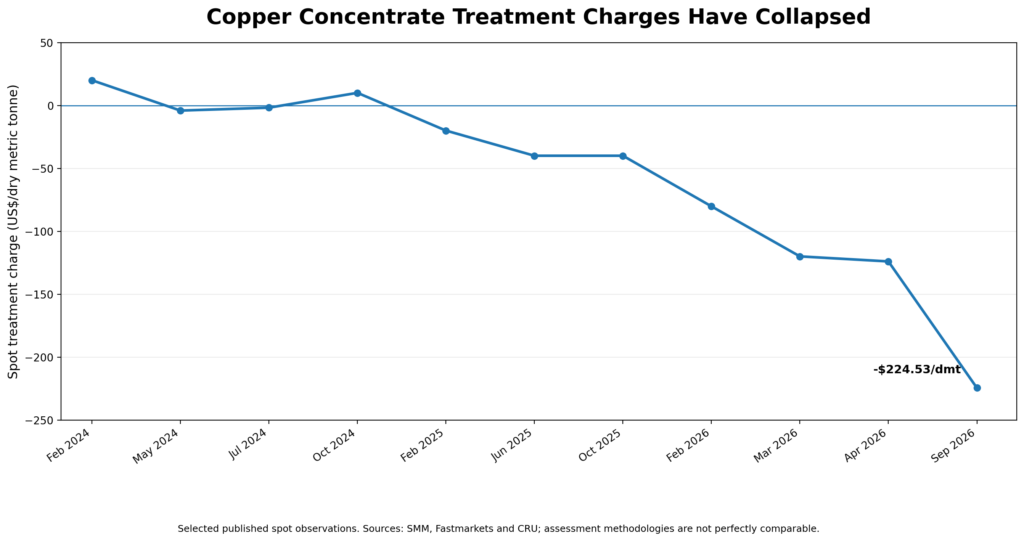
The annual copper concentrate treatment charge benchmark for 2026 settled at zero. Spot treatment charges have gone considerably further and have been negative since 2024. By mid-September, SMM’s spot copper concentrate TC index was around minus US$222/t.
That is an extraordinary number.
Normally a miner pays a smelter to turn concentrate into refined copper. At negative treatment charges, that relationship is effectively being reversed. Smelters are competing so aggressively for available concentrate that the economics of processing it have been turned on their head.
This doesn’t tell us that the world has run out of copper.
It tells us something rather more specific: there is too much smelting capacity chasing too little concentrate.
China is central to this.
Since 2005, China has accounted for more than 90% of the increase in global copper smelting capacity. Its share of global capacity has risen from roughly 15% to around half.
Mine supply has not kept up.
Disruptions at major operations have made the situation worse, but the underlying problem is structural. Building smelting capacity has proved considerably easier than bringing new copper mines into production.
For an existing mine producing clean, saleable concentrate, this is clearly helpful.
For a smelter, it is not.
For an investor, it should be a reminder that buying “copper exposure” can mean exposure to very different parts of the value chain, with very different economics.
Higher prices are hiding lower grades
There is another issue that gets less attention when copper is making new highs.
The industry is having to work harder for each tonne it produces.
S&P Global estimates that average mined copper head grades declined by around 13% between 2012 and 2022, reaching approximately 0.52% Cu.
Strip ratios have also been moving in the wrong direction. The global average fell as low as 1.47:1 in 2021, before increasing to around 1.78:1 in 2024 and an estimated 1.80:1 in 2025.
Neither change sounds particularly dramatic in isolation.
At mine scale, they are.
Lower grades mean processing more tonnes of ore for the same amount of copper. Higher strip ratios mean moving more waste to get to that ore.
Both require more equipment, energy and water. They increase processing requirements, tailings volumes and, ultimately, cost.
A US$14,000/t copper price makes those costs easier to absorb. It doesn’t remove them.
This is why I think mine life and the shape of the future mine plan are becoming increasingly important when comparing existing producers.
Today’s production figure is only part of what an investor is buying.
What happens to grade five years from now? Does the strip ratio increase materially? Is a major pushback required? How much sustaining capital is needed simply to keep production flat? Is underground development eventually required to replace an ageing open pit?
Two companies can produce exactly the same amount of copper today and offer very different exposure to the copper price over the next ten years.
The problem with the enormous copper project
At the other end of the spectrum sit the developers.
There is no shortage of copper resources globally. There are some truly enormous undeveloped deposits.
The problem is increasingly what they cost to build.
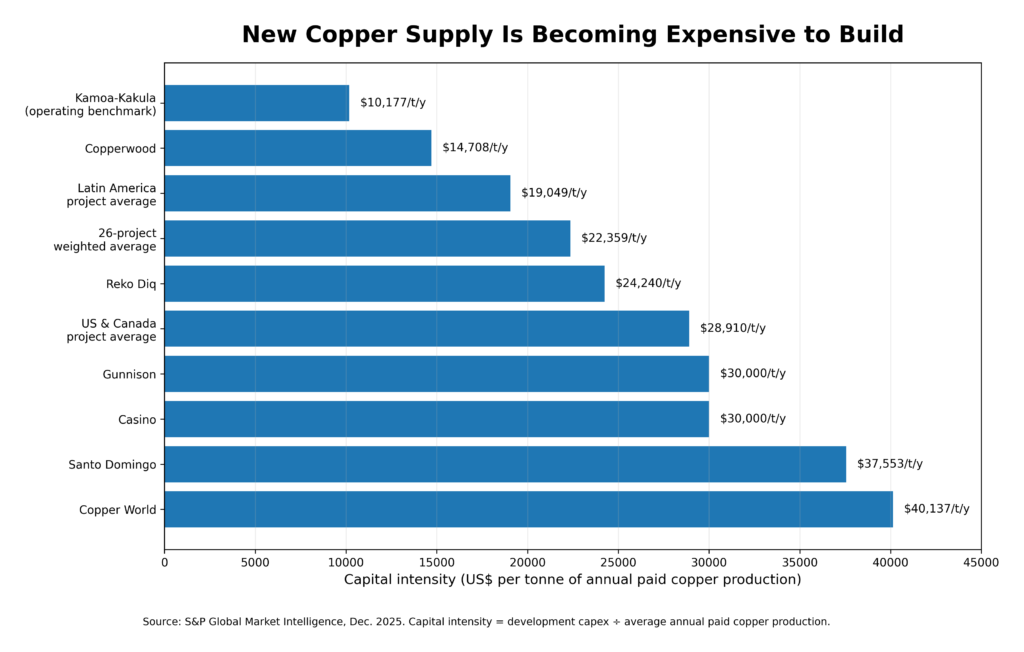
S&P Global recently looked at 26 copper projects expected to start production by 2030. The weighted-average capital intensity was approximately US$22,359 per tonne of annual paid copper production.
Put that into context.
At that capital intensity, a mine designed to produce 200,000 tonnes of copper a year implies development capital of roughly US$4.5 billion.
A 400,000-tonne operation gets you close to US$9 billion.
And that is before considering the inevitable cost overruns that have characterised large mining and infrastructure projects.
This is where I think some of the enthusiasm around undeveloped copper resources needs to be tempered.
A junior company can own an exceptional orebody.
It can publish a very large NPV at US$14,000/t copper.
But if the company itself is worth US$300 million and the mine requires US$5 billion to build, there is still a fairly important question sitting between the resource and the cash flow, namely:
Who is going to pay for it?
A higher copper price helps answer that question. It doesn’t eliminate it.
And the larger the capital requirement, the longer investors need to remain confident in the commodity price. Financing a mine that takes four or five years to construct requires considerably more faith in the copper price than buying an operation that is producing today.
This is why I increasingly think the distinction between a copper resource and future copper supply is being underestimated.
There are plenty of the former.
The market needs the latter.
Perhaps the best new copper mine is an old copper mine
This brings us back to existing producers.
If greenfield copper is becoming extraordinarily expensive to build, the ability to squeeze more production from infrastructure that already exists becomes increasingly valuable.
Brownfield expansions are hardly risk free. They still require capital, engineering and, in many cases, additional permitting.
But they begin with some important advantages: roads, power, water, concentrators, tailings facilities, operating teams and established relationships with governments and local communities.
In a market where a large new mine can take more than a decade to move from discovery to production, an existing mining complex capable of adding another 50,000 or 100,000 tonnes per year starts to look very different.
I would therefore make a distinction between producers that are spending heavily simply to replace declining production and those where existing infrastructure provides a realistic path to growth.
They may both describe their spending as “growth capital”.
Economically, they are not the same thing.
Cost still matters, even at US$14,000 copper
The other thing that tends to happen in a bull market is that investors stop worrying quite so much about the cost curve.
That usually works until it doesn’t.
A mine producing copper at the equivalent of US$2/lb and one producing at US$4/lb both generate substantial margins when copper is above US$6/lb.
But they aren’t equivalent businesses.
The lower-cost producer generates more cash, has greater flexibility to fund expansion and, importantly, has considerably more room for error when copper prices eventually correct.
By-products complicate the comparison further.
Gold, silver and molybdenum credits can transform the cost position of a copper operation. Two mines with similar copper grades and similar production can therefore have very different economics.
This is why simply screening copper companies by annual production or contained resources doesn’t tell us very much.
The quality of those tonnes matters.
A tonne of copper isn’t a tonne of copper
The market often values development companies on some variation of enterprise value per tonne of resource.
It is a useful shorthand.
It can also be deeply misleading.
A tonne of copper sitting beside existing roads, power and a port is not worth the same as a tonne requiring billions of dollars of supporting infrastructure.
A tonne in a permitted project is not worth the same as a tonne in a jurisdiction where permitting may take another decade.
A tonne in a reserve is not the same as a tonne in an inferred resource.
And a tonne expected to be produced in 2028 is certainly not economically equivalent to one that might enter production in 2040.
Peru is a good example of why this distinction matters.
The country has an enormous copper endowment and a mining investment pipeline worth around US$64 billion, approximately 70% of which is copper related. The government would like to increase annual copper production by roughly one million tonnes over the next five or six years.
Yet production has remained broadly around 2.5–2.7 million tonnes.
The copper exists.
Turning it into substantially more annual production has proved rather more difficult.
This is precisely why adding up every announced project and treating the result as future supply tends to overstate how quickly the market can respond.
Capacity is not production. And a resource is certainly not a mine.
So, are copper miners cheap?
Some are.
Some probably aren’t.
And increasingly I don’t think “copper miners” is a sufficiently useful category.
If the structural copper thesis is right, then the assets that interest me most are not necessarily those with the most copper in the ground.
They are the ones capable of converting high copper prices into cash.
That means existing production, sensible costs, long mine lives and expansion opportunities that don’t require rebuilding the entire company.
Among developers, it means projects with manageable capital intensity, credible infrastructure solutions and owners that can realistically finance them.
Grade matters.
Recovery matters.
Jurisdiction matters.
By-products matter.
Balance sheets matter.
And, perhaps more than anything else, the amount of capital required to get from an attractive feasibility study to an operating mine matters.
At US$14,000/t copper, almost every copper project looks better.
That doesn’t necessarily make it a better investment.
The copper trade is changing
I remain constructive on copper’s underlying fundamentals.
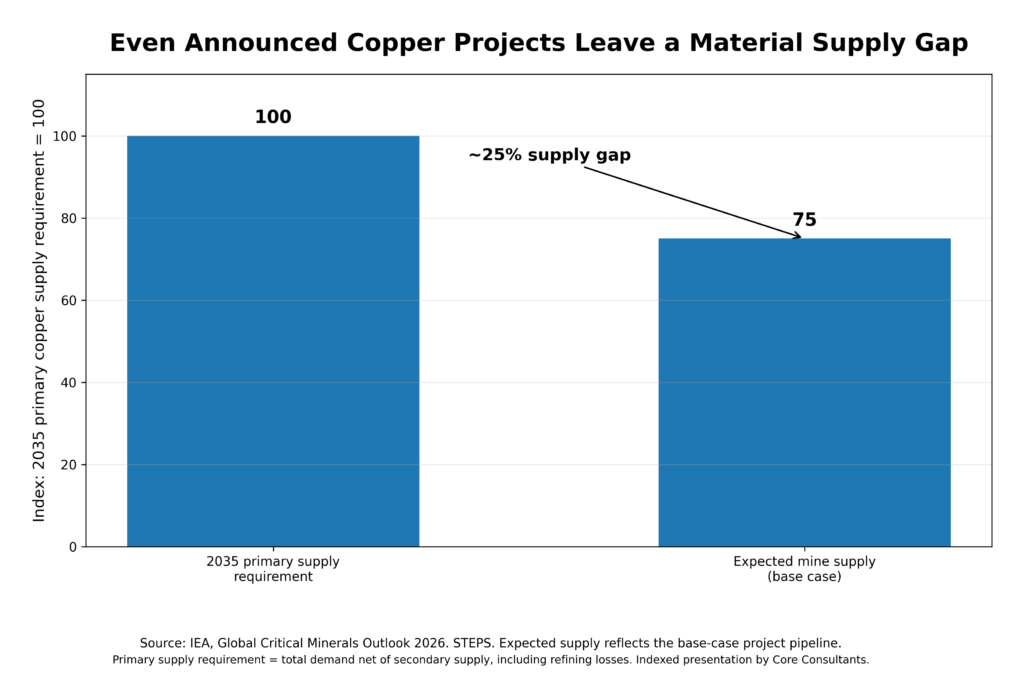
The IEA expects copper demand to increase by around seven million tonnes by 2040. Even allowing for announced projects, it estimates expected mine supply could still be roughly 25% below primary supply requirements in 2035.
That is a very large potential gap.
But it is also increasingly well understood.
The more interesting question for investors is therefore shifting.
It is no longer simply:
Will the world need more copper?
Of course it will.
It is:
Who can actually produce that copper, at what cost, and how much capital will it take to get there?
That is a much harder question.
And I suspect it will be the difference between owning copper and actually making money from it.