For several years, strategic importance was almost an investment thesis in itself. The next phase of the market will be considerably more demanding.
For the past few years, being classified as a critical mineral has been a remarkably effective way of attracting attention (and capital).
Lithium, rare earths, antimony, tungsten, gallium, germanium. The list has expanded, governments have published critical-mineral strategies, and investors have become increasingly interested in companies that might offer exposure to supply chains outside China.
In some cases, the investment argument was relatively straightforward, not to mention rather formulaic. Find a deposit containing a strategically important mineral, demonstrate that Western governments want to reduce their dependence on China, and position the project as part of the solution.
The actual economics of producing that mineral were sometimes a secondary consideration.
That was perhaps understandable when critical minerals were first becoming an important investment theme. The market was trying to identify which materials would matter, where supply was concentrated and which companies might benefit from a change in government policy.
But we are now several years into that process.
We know which minerals are strategically important. We know where much of the supply-chain concentration exists. We also have a growing number of projects competing for capital, government support, off-take agreements and ultimately customers.
The next phase of the critical-minerals market, I suspect, will be considerably less forgiving.
Strategic importance may get a project noticed. It does not necessarily make the company owning it a good investment.
The first trade was about scarcity
There was a period when simply having exposure to a mineral that governments considered critical was enough to generate considerable investor interest.
Lithium was probably the clearest example.
The market correctly anticipated substantial growth in battery demand. Lithium prices rose sharply, capital flowed into exploration and development, and projects that had struggled to attract financing suddenly found themselves at the centre of an investment boom.
The problem was that investors were not simply paying for future lithium demand. They were often paying for an assumption that exceptionally high prices would persist, that new projects would be delivered on schedule and that producers would enjoy attractive margins once operating.
Those assumptions proved optimistic.
In 2016 Robert Friedland famously prophesied that “most lithium mines would end in tears.” He was right.
Lithium prices subsequently fell by more than 80% from their earlier highs, even as underlying demand continued to grow. The IEA’s 2025 Outlook recorded strong lithium consumption growth alongside a sharp deterioration in prices, reflecting how quickly new supply had responded.
The commodity did not stop being strategically important.
Battery demand did not disappear.
But the economics of individual projects changed dramatically.
The same broad lesson applies to nickel. Indonesia’s extraordinary expansion in production has demonstrated that a commodity can be essential to electrification while becoming increasingly difficult for higher-cost producers elsewhere to compete.
And the effect has been visible in investment.
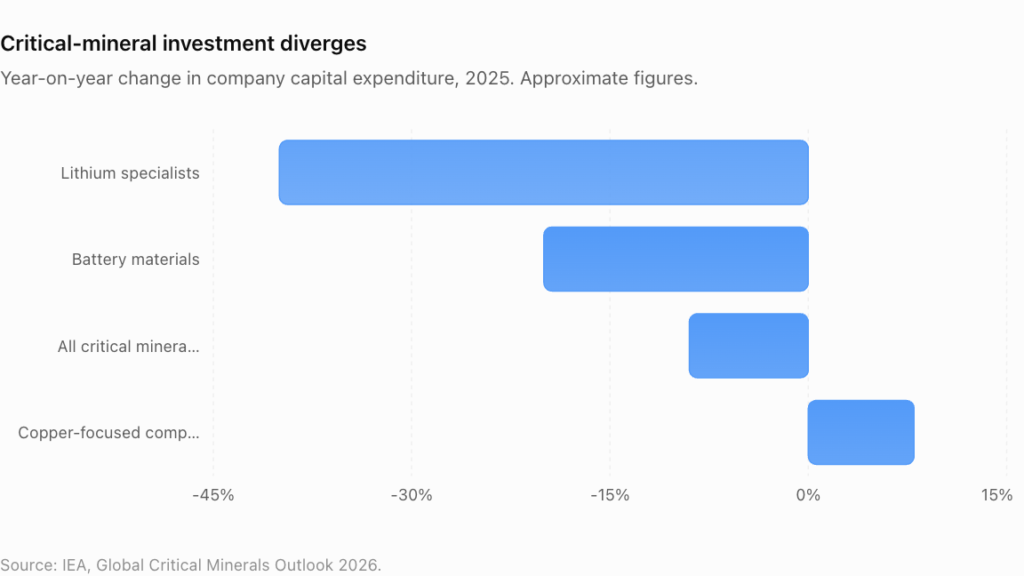
According to the IEA, capital expenditure across critical minerals declined by 9% in 2025. Spending by battery-material companies fell by more than 20%, with lithium-focused companies reducing investment by approximately 40%.
Copper was the exception, with investment increasing 8%.
What I find interesting is not simply that investment has declined. It is that capital is becoming more selective.
Investors are beginning to distinguish between exposure to an attractive commodity and exposure to an attractive business.
That distinction should always have existed. In practice, commodity bull markets have a habit of obscuring it.
A resource is the beginning of the story, not the end
One of the difficulties with investing in emerging mineral supply chains is that there can be an enormous distance between discovering a resource and producing a commercially acceptable product.
A company might publish a substantial mineral resource, complete a preliminary economic assessment, and announce an ambitious production schedule.
None of that necessarily tells us whether it will become a profitable producer.
There are several stages at which the economics can change materially.
The resource must first be converted into something that can be mined economically. Metallurgical recoveries have to be demonstrated, capital and operating costs established, and the project must secure the infrastructure, permits and financing required for construction.
Then comes the part that is frequently underestimated: actually building the operation and getting it to perform as expected.
A project designed to produce 10,000 tonnes annually does not necessarily produce 10,000 tonnes in its first year, or even its third.
Recoveries may be lower than expected. Throughput may be constrained. Reagents can cost more than anticipated. Product specifications may require additional processing. Customers may take longer to qualify the material.
In some cases, the mine works perfectly well but the downstream processing route does not.
This is particularly important for rare earths, graphite and several of the minor metals, where the product that comes out of the ground is often several processing stages removed from the material an industrial customer actually wants.
For investors, the question is therefore not simply how much material a company has identified.
It is how much saleable product that company can realistically deliver, when it can deliver it and at what cost.
There is a considerable difference between owning a strategic resource and operating a strategic business.
Rare earths illustrate the problem particularly well
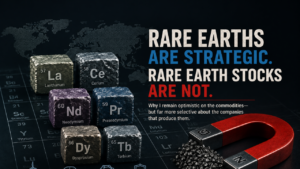
Rare earths have become one of the most visible examples of the critical-minerals investment theme.
China’s dominance of separation, refining and magnet manufacturing is well documented. Its export controls have reinforced the need for alternative supply chains, particularly for industries where access to certain materials is essential.
There is a legitimate strategic argument for developing additional production outside China.
But the investment case for individual rare-earth companies is considerably more complicated.
A deposit containing rare earths is not necessarily a valuable rare-earth deposit.
The composition of the basket matters enormously.
A resource dominated by lower-value cerium and lanthanum is economically different from one with substantial neodymium and praseodymium content, or meaningful exposure to dysprosium and terbium.
Even then, the basket value is only part of the equation.
Mineralogy, recoveries, separation requirements, reagent consumption, waste management and product specifications can make the difference between an attractive project and one that struggles to compete.
A company may have a large resource and an impressive headline basket value, but if it cannot produce separated products at a competitive cost, the strategic importance of the deposit does little for shareholders.
Nor should investors assume that Chinese prices will necessarily remain sufficiently high to support every Western development.
China has spent decades building an integrated rare-earth industry. Its competitive advantage extends well beyond the resource base.
For a new entrant, the challenge is not simply to produce rare earths. It is to produce the right products, at the required specification, in sufficient volumes, at costs that customers or governments are prepared to support.
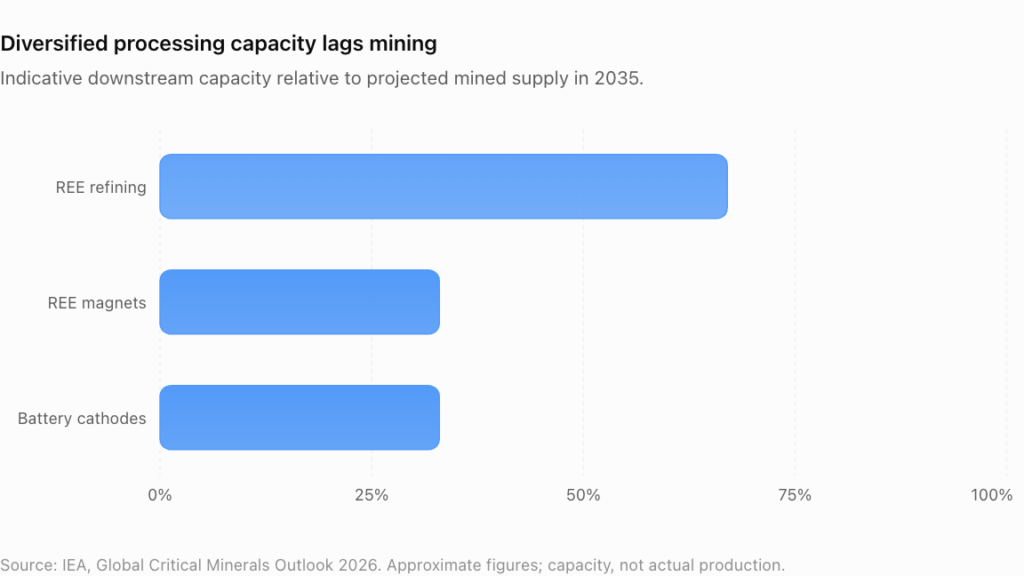
This is why I anticipate that the market will increasingly distinguish between companies with a credible route to commercial production and those whose principal attraction remains the strategic importance of their resources.
The latter may still attract speculative capital.
The former have a better chance of building sustainable businesses.
The value of an off-take agreement is changing
Another area where I expect investors to become more discerning is off-take.
For many development companies, announcing an off-take agreement has historically been treated as an important milestone.
And it can be.
An agreement with a credible industrial customer may demonstrate that there is genuine demand for a project’s output. It can help establish product specifications, support financing and reduce uncertainty around future sales.
But not all off-take agreements are equivalent.
Some are binding commitments. Others (most, in fact) are memoranda of understanding or expressions of interest.
Some contain meaningful pricing provisions. Others leave the commercial terms to be negotiated later.
Some require the project to deliver material that has already been qualified by the customer. Others are conditional on successful qualification.
There is also a difference between an agreement to purchase material and an agreement that makes a project financeable.
A lender will want to understand who the buyer is, what obligations the buyer has assumed, how prices are determined and whether the contracted revenues are sufficient to support debt service.
A company announcement stating that a customer is interested in its product may be encouraging.
It is not the same as having a bankable revenue stream.
As more critical-mineral projects move towards financing, I suspect investors will pay considerably more attention to these distinctions.
The same applies to strategic partnerships.
A large industrial name appearing in a company presentation is useful. A partner committing capital, technical expertise, product qualification and binding purchases is something rather different.
Government support is becoming part of the business model
There is an important qualification to all of this.
Not every strategically important project will be expected to compete purely on conventional commercial terms.
In fact, I suspect an increasing number will not.
Governments are recognising that some mineral supply chains are too concentrated to leave entirely to the lowest-cost producer.
That creates a different investment proposition.
A project might be commercially unattractive at prevailing market prices but strategically valuable because it provides domestic supply, reduces exposure to export restrictions or supports an essential manufacturing industry.
If governments are prepared to pay for that security through procurement commitments, price-support arrangements or other mechanisms, the economics can change substantially.
The distinction is whether that support is real, durable and sufficient.
Consider the difference between a government announcing that a mineral is critical and a government committing to purchase a defined quantity of material at an agreed price.
The first may improve sentiment.
The second can materially alter project economics.
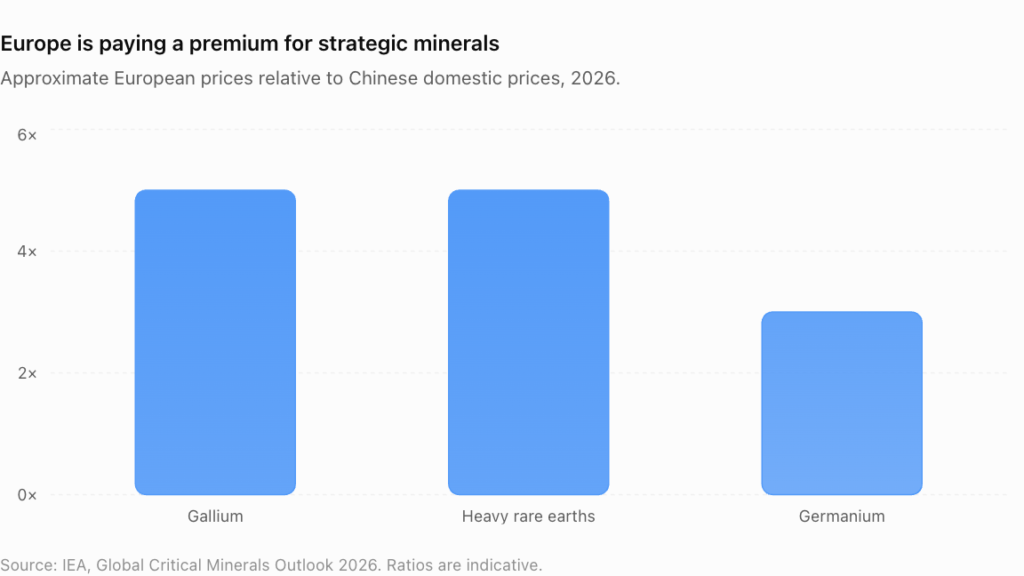
This is becoming increasingly relevant as governments move from publishing critical-mineral strategies to participating directly in supply chains.
But it also introduces another set of risks for investors.
What happens when a support agreement expires? Is the company profitable without it? Could the terms change following a change in government? Does the arrangement benefit ordinary shareholders, or does most of the economic value accrue to the government or strategic partner?
These are questions investors will increasingly have to answer.
A strategically supported business can be a very good investment. But investors need to understand exactly what is being supported, for how long and who captures the benefit.
The companies that deliver will not necessarily be those with the largest resources
One consequence of the current investment environment is that smaller, less ambitious projects may become more attractive than enormous developments that require billions of dollars to finance.
A project does not have to transform global supply to be commercially successful.
This is particularly true for smaller critical-mineral markets.
In tungsten, antimony or gallium, a relatively modest quantity of reliable production outside the dominant supplier can have strategic significance.
But the economics still matter.
A project with manageable capital requirements, established infrastructure, a straightforward processing route and a credible customer may be more valuable than a much larger resource requiring an entirely new industrial complex.
The same logic applies to brownfield opportunities.
Existing mines, refineries and smelters may offer opportunities to recover additional critical minerals without having to finance an entirely new operation.
This is especially relevant for gallium, germanium, indium and several other by-product metals.
Their production is often linked to the economics of a much larger host-metal industry.
A company announcing a gallium resource is not necessarily creating new gallium supply. The commercial question may be whether an existing alumina refinery can recover gallium economically, whether it can produce the required purity and whether there is a qualified buyer for the product.
Similarly, germanium supply cannot be assessed independently of the zinc and other processing operations from which it is recovered.
In these markets, the most attractive opportunities may not be conventional junior mining companies at all.
They may be established industrial businesses capable of recovering additional value from existing material streams.
That is a rather different investment universe from the one that attracted attention during the first phase of the critical-minerals boom.
A higher commodity price can also create a dangerous illusion
One of the recurring features of mining investment is the speed at which project economics improve when commodity prices rise.
This is particularly evident in some of the smaller critical-mineral markets, where prices have moved sharply in response to export restrictions and supply concerns.
The IEA reports that tungsten prices increased approximately sixfold between January 2023 and April 2026, while prices for several other strategic minor minerals more than doubled.
These price movements can transform project valuations.
A feasibility study based on substantially higher commodity prices may produce an exceptional NPV and internal rate of return.
But investors need to consider how much of that apparent value comes from the underlying quality of the project and how much comes from the price assumption.
A project that generates attractive returns at conservative prices is not equivalent to one that requires today’s elevated prices to justify construction.
This becomes especially important when the commodity market is small.
A single new producer can represent a meaningful proportion of global supply. If several projects are financed using similarly optimistic price assumptions, the eventual supply response may undermine the prices on which their economics depend.
That is not an argument against investing in these commodities.
It is an argument for being considerably more careful about the price assumptions embedded in development valuations.
The investment case should not depend entirely on the market remaining in a state of exceptional scarcity indefinitely.
The next phase will reward execution
I don’t think the critical-minerals investment theme is ending.
Quite the opposite.
Supply-chain concentration, industrial policy, defence requirements and the need for reliable access to strategic materials are likely to remain important drivers of investment for years to come.
But I do think the market is entering a different phase.
The first phase was largely about identifying strategic vulnerabilities and the companies that might benefit from addressing them.
The next will be about determining which of those companies can actually deliver.
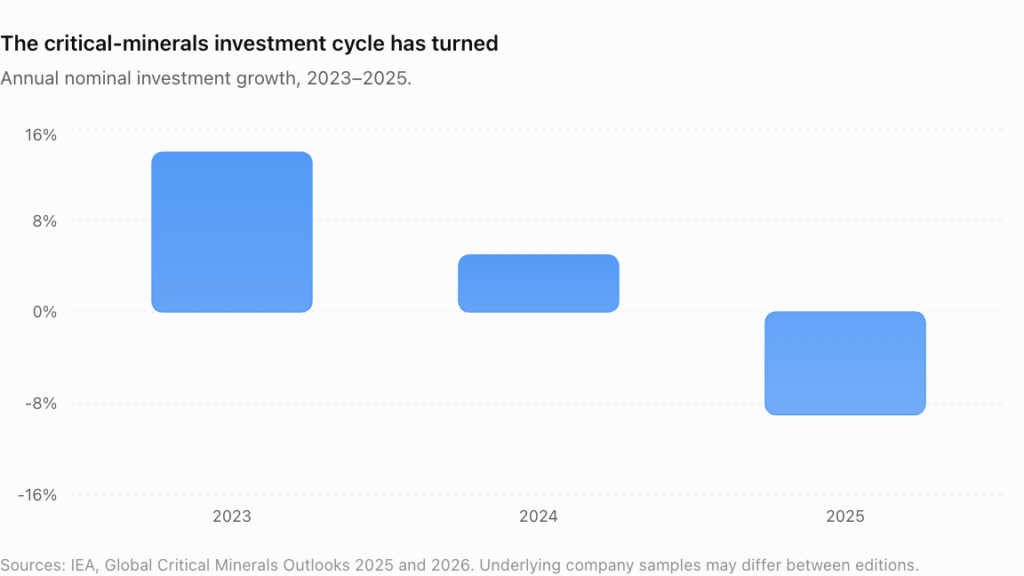
That means looking more closely at the quality of resources, the credibility of production forecasts, capital intensity, operating costs, processing capabilities, financing arrangements and the commercial substance of off-take agreements.
It also means accepting that some projects will have strategic value without necessarily offering attractive returns to equity investors.
There will still be speculative opportunities. Commodity prices will still move sharply, and companies with relatively little operating substance may continue to outperform during periods of market enthusiasm.
Mining has always been cyclical, and critical minerals will be no exception.
But over time, the distinction between a strategically interesting deposit and a commercially successful producer should become much clearer.
For investors, that creates an opportunity.
Rather than simply asking whether a company has exposure to a critical mineral, the more useful questions are whether it can finance its project, whether it can produce a product that customers actually need, whether it can compete at realistic prices and whether shareholders will ultimately participate in the value created.
Those questions are considerably harder to answer than identifying which minerals appear on a government critical-minerals list.
They are also far more important.
The first critical-minerals trade rewarded scarcity and strategic positioning. The next will increasingly reward execution.
And in an industry where the distance between discovering a resource and generating free cash flow can be enormous, that is a distinction worth making.
About Metal Intel
Metal Intel is the independent commodity intelligence series published by Core Consultants, examining the markets, projects and economics shaping global mineral supply chains.
Subscribe for weekly independent commentary on critical minerals, commodity markets and mining investment.
Metal Intel Research | 2027 Strategic Brief Series
Our 2027 research programme covers Copper, Rare Earths, Tungsten, Antimony, Gallium & Germanium and Tin, combining independent market analysis with asset-level intelligence, supply-demand forecasts and project economics.
For institutional research subscriptions or bespoke consulting mandates, visit www.coreconsultantsgroup.com or contact lara@coreconsultants.org.